The capture changes more than you expect
En passant has an unusual visual trap. Your pawn moves diagonally to an empty square, while the captured pawn disappears from a different square. If you picture only the destination, you can miss a newly opened line to your king.
The ordinary conditions still apply: the opposing pawn must have just advanced two squares from its starting square, and the capture must be made on the immediately following move. King safety is a separate requirement. A move that exposes your own king to attack is illegal, including an en passant capture.
Sources: FIDE Laws of Chess
When the fifth rank opens
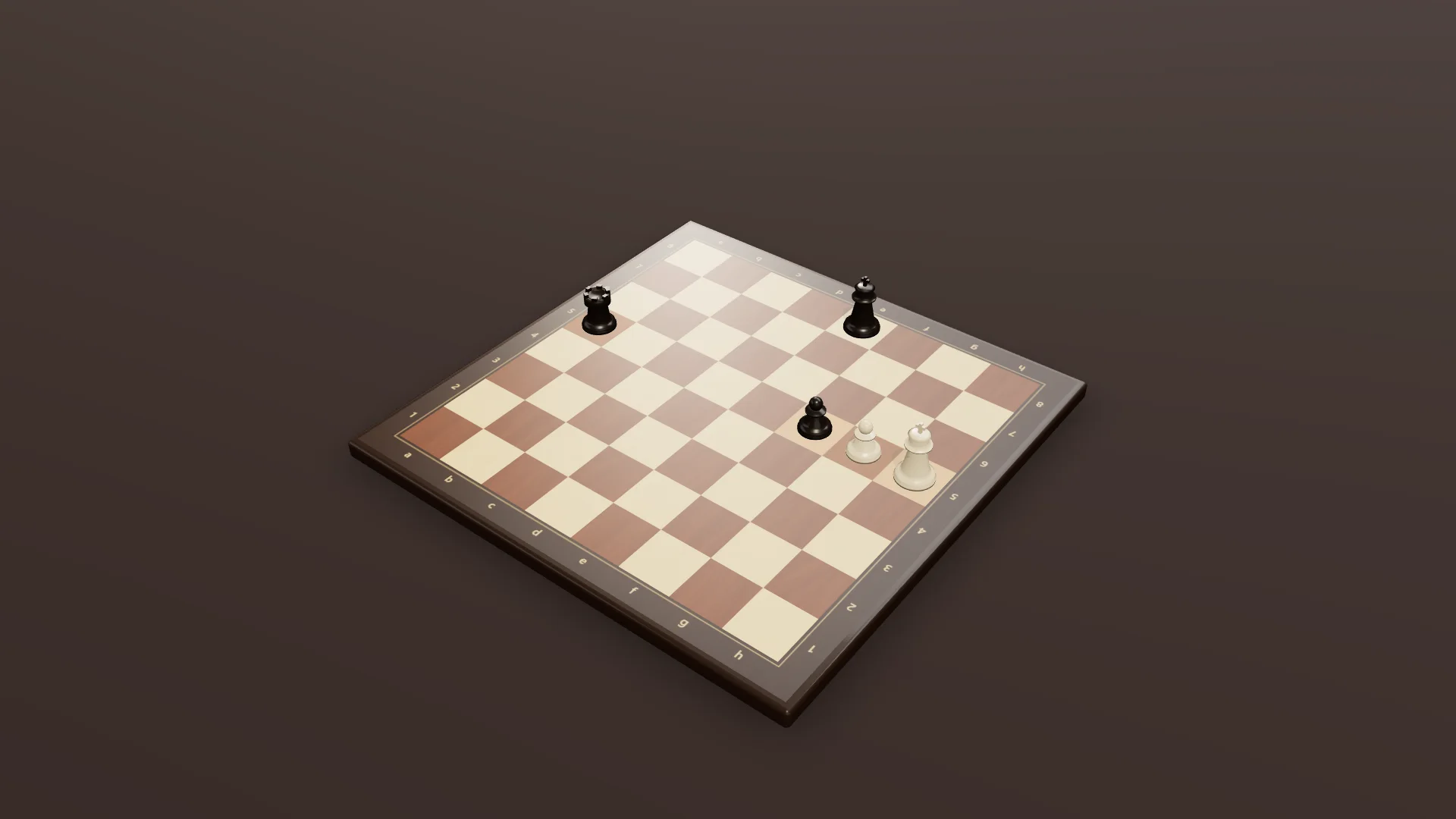
Look at this constructed example. Black's rook stands on a5, White's king on h5. Between them are Black's pawn on f5 and White's pawn on g5. At the moment, those pawns interrupt the rook's line across the fifth rank. White is not in check.
The tempting capture is gxf6 en passant. Imagine its complete effect: the white pawn leaves g5 and arrives on f6; the black pawn is removed from f5. Both f5 and g5 are now empty. Nothing remains between a5 and h5, so the rook attacks White's king.
The capture is therefore illegal. It does not matter that White's pawn would be safe on f6, or that the timing condition was satisfied. The move is judged by the safety of the king in the resulting position. White must choose another move.
Move the king one square
Now keep every piece in the same place except the white king. Put it on h4. Black has again just played ...f5. The capture gxf6 still empties f5 and g5, and the rook still gains an open fifth rank. But the white king is no longer standing on that rank.
In this second position, the capture is legal. No black piece attacks h4 after it. One square has changed the answer because legality depends on the whole board, not just the two pawns. Compare the examples without making a move first; being able to visualize the difference is the skill you want to take into a real game.
Make the call
Choose whether the capture is legal, then switch to the comparison position. In the legal example, you can play the capture to see exactly which pawn disappears. In the illegal example, the board will not permit a move that exposes the king.
Your move
Put the idea to the test
Black has just played ...f5. Is gxf6 en passant legal with the white king on h5?
Explore in 3D, or switch to 2D.A quick check for your next game
- Confirm that the opponent's last move was the required two-square pawn advance.
- Place your pawn on its destination in your mental picture.
- Remove the opposing pawn from the square it actually occupies.
- Trace every newly opened rook, bishop, or queen line toward your king.
This example uses a rook because the opened rank is easy to see. The habit is broader: evaluate the final arrangement, including every removed piece. When a chess interface refuses an apparent en passant capture, check the timing and your king's lines before assuming that the rule has been implemented incorrectly.
Sources & further reading
- FIDE Laws of Chess
Articles 3.7.3.1–3.7.3.2 define en passant; Article 3.9.2 requires king safety. The two teaching positions are original and checked with chess.js.
Prepared with AI assistance. The board positions and move sequences are automatically checked for legality. This preview is awaiting independent editorial review.
Take it to the board
Practice the full en passant rule
Learn the timing, direction, and capture with more interactive examples.